
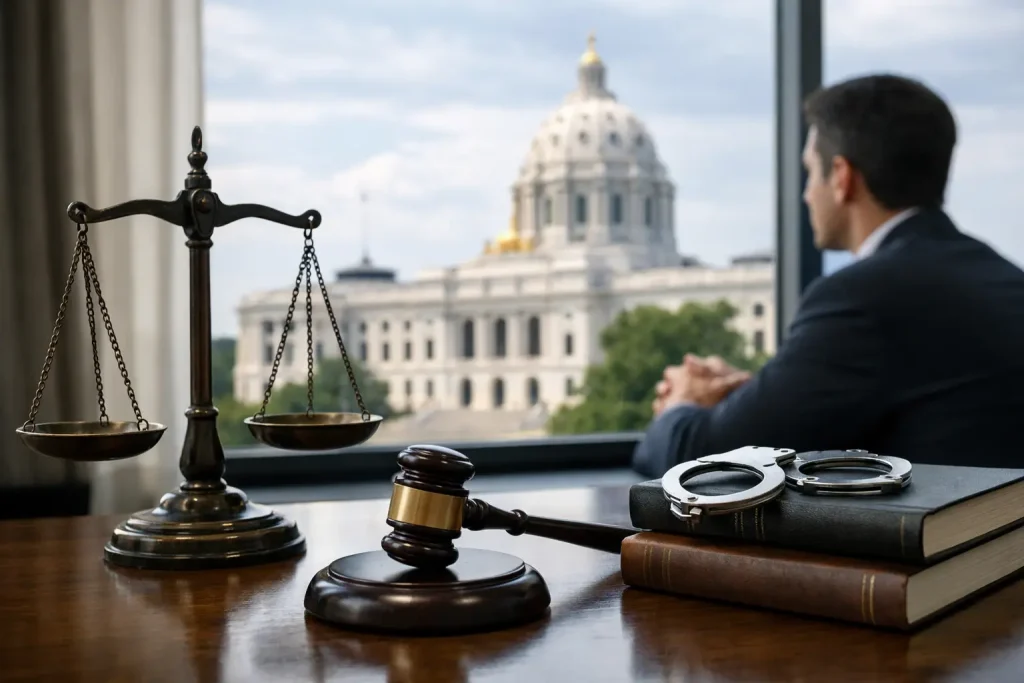
A felony accusation can change the temperature of a room in minutes. A detective wants to “clear something up.” Officers ask for a statement. A loved one learns there may be a warrant, a bail hearing, or a court date. At that point, a Minnesota felony defense lawyer is not a luxury or a last step. Counsel is the shield between you and a system built to investigate, charge, and punish.
The state may already have police reports, recordings, forensic testing, witness statements, and a theory of the case. That does not mean its case is complete, fair, or provable. It means the defense must move with purpose. What you say, what you sign, and what you do in the first days can affect your freedom, your family, your job, your firearm rights, and your future.
What makes a felony charge different?
Minnesota felonies carry the possibility of more than one year of incarceration. But the stakes extend well beyond the sentence listed in a statute. A conviction can create a lasting criminal record, affect housing and employment opportunities, disrupt professional licenses, limit firearm rights, complicate immigration status, and strain custody or family-law matters.
A felony case can arise from an allegation of assault, domestic violence, theft, burglary, drug possession or sale, firearms conduct, criminal sexual conduct, or an impaired-driving offense with aggravating circumstances. Some cases begin with an arrest. Others begin with a search warrant, an investigator’s phone call, a protective order, or a request to come to the station.
The charge itself is not a verdict. Prosecutors must still prove every required element beyond a reasonable doubt. The difference between an accusation and proof is where a serious defense is built.
What to do when police contact you
Stress makes people want to explain. That instinct is understandable, but it can be costly. Police are trained to gather information, test accounts, and look for admissions. A statement meant to sound cooperative can be taken out of context, compared against other evidence, or used to fill a gap in the state’s case.
Remain calm. Do not lie, resist, delete messages, destroy property, contact an alleged victim in violation of an order, or attempt to coordinate stories with witnesses. Those choices can create new legal problems.
You can clearly state that you want a lawyer and do not want to answer questions. Then stop discussing the facts. This is not about appearing guilty. It is about protecting a constitutional right before you understand the allegation, the evidence, or the consequences.
If officers seek consent to search your phone, vehicle, home, or other property, do not assume you must agree. Warrants, consent, probable cause, and search exceptions all matter. A Minnesota felony defense lawyer can assess how evidence was obtained and whether law enforcement stayed within constitutional limits.
The first defense decisions can shape the whole case
Felony defense is not simply waiting for a trial date. The early work often determines what options exist later. At a first appearance or bail hearing, the court may decide whether a person remains in custody, what release conditions apply, and whether no-contact, travel, alcohol-monitoring, or firearm restrictions will be imposed.
Those conditions can be difficult, especially when the allegation involves a spouse, partner, household member, workplace, or shared home. Violating a release condition can lead to arrest and make the original case harder to defend. Read every condition carefully and treat it as an order, not a suggestion.
A defense attorney also begins preserving evidence. Surveillance footage can disappear. Phone data can be overwritten. Witness memories change. Physical evidence may need independent review. In an alleged DWI involving alcohol, THC, prescription medication, or another controlled substance, the timeline of driving, testing, observations, medication use, and actual impairment may be central.
There may also be separate deadlines outside the criminal case. For certain impaired-driving arrests, Minnesota license-revocation review deadlines can be short, including a 60-day deadline to seek judicial review in many implied-consent matters. Missing a civil deadline can leave a license revocation in place even while the criminal case continues.
How a Minnesota felony defense lawyer tests the state’s case
A strong defense does not rely on a single dramatic courtroom moment. It is built by examining each link in the state’s chain of proof. That work may include reviewing body-camera footage, dispatch records, 911 calls, search-warrant affidavits, interview recordings, lab procedures, medical records, digital evidence, and the credibility of every witness.
The right strategy depends on the facts. In one case, the key question may be whether police had a lawful basis for a stop, arrest, search, or seizure. In another, it may be whether an eyewitness had a clear opportunity to identify the person involved. A drug case may turn on possession, knowledge, constructive possession, testing procedures, or whether someone else controlled the area where drugs were found.
In a violent-crime or domestic-violence case, the defense may examine self-defense, defense of another person, inconsistent accounts, injuries, the history between the parties, and whether the allegation matches the physical evidence. In a theft or property case, intent, ownership, value, identity, and authorization can be disputed. The label on the complaint does not tell the whole story.
Former prosecution and law-enforcement experience can matter here because it helps the defense anticipate how an investigation may be organized and how a prosecutor may frame the evidence. But experience only matters when it is used to build a targeted strategy for the person facing the charge.
A plea is a decision, not an automatic answer
Many felony cases resolve without a jury trial. That does not mean every plea offer is wise, or that trial is always the right path. The decision depends on the evidence, available defenses, sentencing exposure, collateral consequences, the client’s goals, and the risks of litigation.
Sometimes the defense can seek dismissal, suppression of unlawfully obtained evidence, a reduction in the charge, or a more favorable resolution. Sometimes a trial is necessary because the state cannot prove the case. In other situations, a negotiated outcome may protect a client from a greater risk. There is no honest one-size-fits-all answer.
Before accepting any agreement, a person should understand exactly what they are admitting, what sentence or probation conditions may follow, whether a conviction affects firearms or immigration status, and whether there are consequences for employment, licensing, driving privileges, or family relationships. A quick resolution can feel like relief, but a felony record can follow someone long after court supervision ends.
Questions to ask before hiring felony counsel
When your liberty is at risk, look for more than a familiar name or a promise that everything will be fine. Ask who will handle your case, how quickly they can begin investigating, whether they have defended charges like yours, and how they will communicate with you about urgent developments.
You should also ask how the attorney evaluates police conduct, forensic evidence, witnesses, and plea offers. A lawyer should be direct about uncertainty. No one can guarantee a result. What committed counsel can provide is preparation, clear advice, and a defense designed around the evidence rather than fear.
At Refuge Defense, the work begins with the person behind the accusation. A charge may be serious, but it does not erase your dignity, your relationships, or your right to be heard. The goal is to create a legal stronghold around what matters most: your freedom, your record, and the life you are fighting to protect.
Do not let the accusation write the next chapter
A felony investigation or charge can make the future feel decided before you have had a chance to respond. It is not decided. Preserve what you can, follow court orders, keep the facts off social media, and get legal advice before making statements or major decisions. The state has its process. You deserve a defense prepared to meet it with truth, discipline, and resolve.