
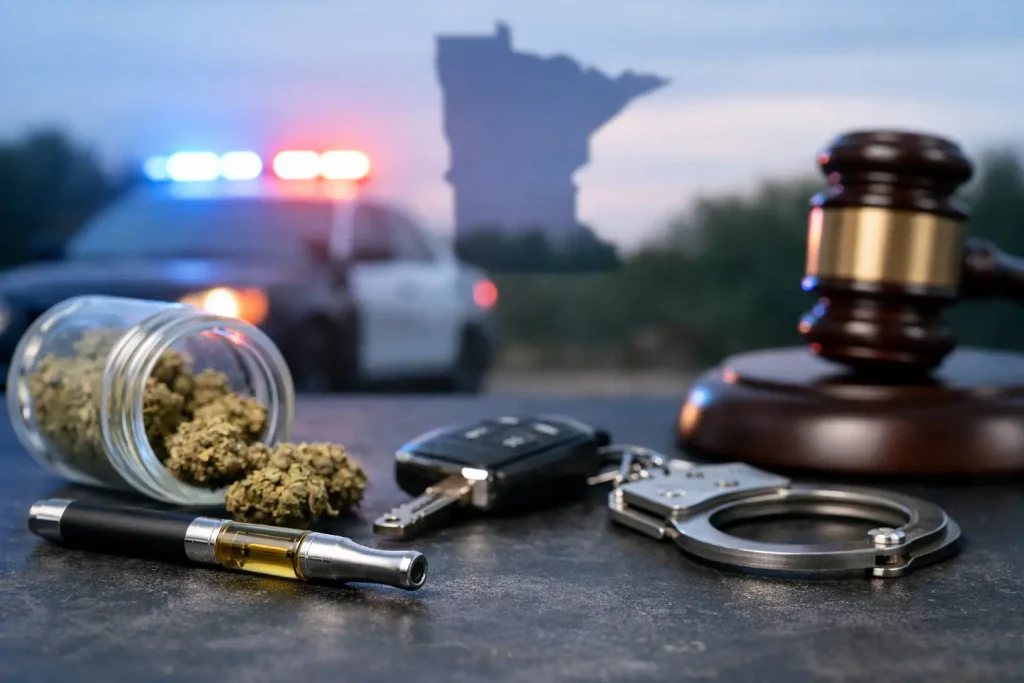
A traffic stop can turn into a criminal case quickly. Can THC cause a DWI in Minnesota? Yes. Even though adult-use cannabis is legal in Minnesota, driving while impaired by THC remains illegal. A cannabis-related DWI can threaten your license, job, freedom, reputation, and family stability.
But a positive THC test does not automatically prove that you were impaired while driving. Minnesota does not use a simple THC blood-level limit like the .08 alcohol standard. The state must still build a case showing impairment, and every part of that case deserves close scrutiny.
Can THC Cause a DWI in Minnesota?
Minnesota law prohibits driving, operating, or being in physical control of a motor vehicle while under the influence of cannabis, a controlled substance, or another impairing substance. The key question is not whether you used cannabis at some point. The question is whether THC affected your ability to drive at the relevant time.
That distinction matters because THC and its metabolites can remain detectable after the noticeable effects have ended. Frequent users may test positive days or longer after use, depending on the test and the person. A test result may be part of the state’s evidence, but it does not answer every question about actual impairment behind the wheel.
Police and prosecutors commonly rely on a combination of driving conduct, officer observations, statements, field sobriety exercises, drug-recognition evaluations, and blood or urine testing. Each category can be challenged. A case is not decided merely because an officer smelled cannabis or because a laboratory detected THC.
Legal Cannabis Does Not Create a Right to Drive Impaired
Minnesota’s cannabis laws changed, but the basic rule of the road did not: do not drive after using a substance that impairs you. The same warning applies to marijuana flower, edibles, concentrates, vape products, medical cannabis, and products marketed as hemp-derived THC.
Edibles create a particular risk. Their effects may take longer to arrive and can last longer than someone expects. A driver may believe they are fine because they consumed an edible hours earlier, then encounter delayed or lingering effects while driving home.
Prescription medication can complicate the picture as well. If cannabis is combined with alcohol, sleep medication, anxiety medication, pain medication, or another drug, police may claim the combination caused impairment. A lawful prescription is not a complete defense to an impaired-driving allegation, but the state still has to prove its case.
What Evidence May Police Use in a THC DWI Case?
A cannabis DWI investigation often begins with an officer claiming to see poor driving: drifting, braking inconsistently, speeding, driving too slowly, or failing to signal. Sometimes the initial reason for the stop is minor, such as an equipment issue or expired tabs. From there, an officer may look for signs they associate with cannabis impairment.
Those signs can include red eyes, dilated pupils, an odor of marijuana, slow speech, confusion, unsteady movement, or an admission of recent use. Yet many of these observations have innocent explanations. Fatigue, allergies, anxiety, contact lenses, medical conditions, roadside lighting, and the stress of a police encounter can affect how a person looks and performs.
Officers may ask you to complete field sobriety tests. These tests were primarily developed around alcohol impairment and are not a scientific THC meter. They can be affected by uneven pavement, cold weather, footwear, injuries, neurological conditions, age, and unclear instructions. A nervous driver does not become impaired simply because an officer writes “clues” on a report.
In some investigations, an officer trained as a Drug Recognition Evaluator, or DRE, may conduct a more extensive evaluation. That evaluation can carry weight with a jury, but it is not beyond challenge. The defense can examine the officer’s training, the testing conditions, whether medical explanations were considered, body-camera footage, and whether the officer jumped to a conclusion before gathering the facts.
A Positive THC Test Is Not the Same as Present Impairment
This is often the central defense issue. Alcohol cases use a defined per se limit: a .08 alcohol concentration can independently support a DWI charge. THC cases are different. Minnesota does not have a comparable blood-THC number that automatically establishes guilt.
Blood and urine tests detect different substances and tell different stories. THC in a blood sample may be more closely tied to recent use than a urine result, but it still does not precisely establish when someone used cannabis or how impaired they were at the time of driving. Urine testing can detect inactive metabolites that may remain long after the impairing effects are gone.
Timing also matters. A sample is usually collected after the traffic stop, after the roadside investigation, and sometimes after transport to a medical facility or jail. The state may have to explain what the result means at the time you were actually operating the vehicle, not merely when the sample was taken.
Laboratory procedures deserve examination, too. Chain of custody, sample handling, test methodology, reporting language, and the qualifications of those involved can all matter. The government’s evidence must be tested, not accepted on faith.
What Happens If You Refuse a THC Chemical Test?
After an arrest, Minnesota’s implied-consent law may require a driver to make a high-stakes decision about chemical testing. In a suspected drug DWI, police may seek a blood or urine sample. Refusal can lead to its own criminal charge and serious driver’s-license consequences.
Do not assume that refusing a test makes the case disappear. It can create another allegation and may lead police to seek a warrant for a blood sample. On the other hand, the legality of the arrest, the advisory you received, the request for testing, a warrant, and the claimed refusal may all be issues a defense lawyer needs to investigate.
If your license has been revoked after a DWI arrest, time matters. Minnesota generally gives you 60 days to file a petition challenging the revocation. Missing that deadline can close off a vital avenue to fight for your driving privileges. Protecting your license is not a side issue. For many people, it is how they get to work, care for children, attend school, and hold life together while the criminal case moves forward.
What to Do After a Cannabis DWI Arrest
Do not try to explain your way out of the case through casual calls, texts, or social-media posts. Your words can be misunderstood, quoted out of context, or used to strengthen the state’s theory. Preserve documents from the stop, towing paperwork, bail conditions, license notices, and any test paperwork.
Write down what you remember as soon as you can: where you were driving, why the officer stopped you, what was said, whether you were read an advisory, what tests you performed, and whether there was body-camera footage. Details fade quickly, and small details can become significant later.
Then speak with a Minnesota DWI defense attorney promptly. A targeted defense may challenge the basis for the stop, the expansion of the investigation, field sobriety testing, claimed impairment signs, chemical-test procedures, or the connection between a THC result and driving impairment. The right strategy depends on the evidence, your record, your license status, and the charge level.
A THC DWI accusation is not a verdict on your character, and it is not a case you have to face alone. When the legal storm starts closing in, move quickly to protect the ground beneath your feet. Refuge Defense stands ready to examine the state’s case and fight for your rights, your license, and your future.
Pingback: Minnesota Blood Test Warrant in a DWI Case – Refuge Defense