
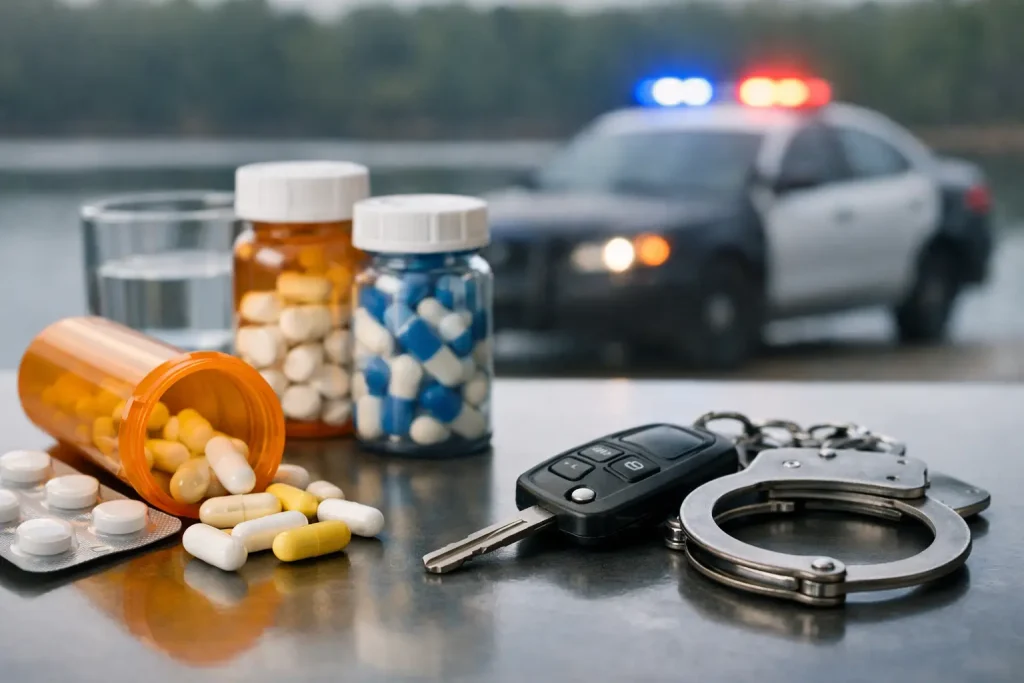
A prescription bottle in your name does not end a Minnesota DWI case. But it does not prove impairment either. In a prescription medication DWI defense Minnesota drivers need, the central question is not whether you took a lawful medication. It is whether the state can prove that the medication actually impaired your driving or physical control of a vehicle at the relevant time.
That distinction can get buried beneath flashing lights, roadside tests, a drug-recognition evaluation, and a lab report with a medication name highlighted in bold. The state may treat those facts as a ready-made case. They are not. Your license, job, family stability, and freedom deserve a defense built on evidence, timing, medical facts, and the actual law – not assumptions about a prescription.
A Legal Prescription Can Still Lead to a DWI Arrest
Minnesota law allows DWI allegations based on alcohol, controlled substances, or other substances that impair a person’s ability to drive. A person can be arrested after taking medication exactly as prescribed. Pain medications, sleep aids, anti-anxiety drugs, stimulants, muscle relaxers, and certain combinations of medications may all draw police attention.
Lawful use is therefore not an automatic shield. At the same time, a positive test for a prescription drug is not the same thing as proof of impaired driving. Many medications remain detectable long after their impairing effects, if any, have passed. Some drivers have taken the same medication for years and have developed tolerance. Others may show signs that an officer mistakes for impairment but that have a different explanation, including fatigue, illness, injury, anxiety, a neurological condition, or poor roadside conditions.
A strong defense begins by separating what police suspected from what they can actually prove.
What the State Must Show in a Prescription Drug DWI Case
The prosecution generally must establish that you drove, operated, or were in physical control of a motor vehicle while under the influence of a controlled substance or another impairing substance. The exact charging theory matters. So do the facts surrounding the stop, the arrest, and any chemical test.
Unlike many alcohol cases, there is usually no simple blood-alcohol number that settles a prescription-medication case. A toxicology result may identify a drug or metabolite, but it often cannot tell a jury how impaired a person was at the moment of driving. Concentration levels, dosage history, the time medication was taken, metabolism, tolerance, and the interaction of multiple substances can all matter.
The state’s case may rely heavily on officer observations: alleged weaving, delayed responses, red or watery eyes, slurred speech, unsteady balance, or performance on field sobriety tests. Those observations must be tested, not accepted as fact. Was the driving conduct truly unsafe? Was the stop lawful? Did the officer account for weather, darkness, footwear, a prior injury, age, or a medical condition? Was a driver understandably nervous during a roadside encounter?
A conviction cannot rest on a label. “Prescription drug” is not a synonym for “impaired.”
Drug-recognition evaluations are not beyond challenge
Police may call a drug recognition evaluator, often called a DRE, after an arrest. The evaluator follows a multi-step process that can include eye examinations, pulse measurements, balance tests, questions about medical history, and an opinion about a suspected drug category.
That process may sound scientific, but it remains dependent on the evaluator’s training, observations, documentation, and interpretation. A defense should scrutinize whether the evaluation was completed correctly, whether the claimed clues fit the medication involved, and whether other medical explanations were ignored. Video footage can be especially revealing when it does not match the written report.
Chemical tests answer limited questions
Blood or urine testing may identify medications, metabolites, or other substances. The defense should examine the collection process, laboratory procedures, chain of custody, reporting limits, and the difference between an active drug and an inactive metabolite.
Even a reliable lab result has limits. It can support the claim that a substance was present, but presence is not necessarily impairment. A careful defense may use prescription records, medical records, pharmacology evidence, and an independent expert review to put the result in its proper context.
Building a Prescription Medication DWI Defense in Minnesota
There is no one-size-fits-all defense. The right strategy depends on the medication, the alleged driving conduct, the test results, your medical history, and how officers handled the investigation. The strongest cases often involve several lines of defense working together.
First, the traffic stop itself must be examined. Police need a lawful basis to stop a vehicle. A vague claim of poor driving may be less persuasive when squad video shows normal driving, a brief lane touch caused by road conditions, or conduct that did not violate traffic law.
Second, the arrest decision must be challenged where appropriate. Officers need more than a hunch to arrest. If the alleged signs of impairment were weak, medically explainable, or contradicted by body-camera footage, the state may have a proof problem.
Third, the defense can confront the claimed connection between the medication and driving ability. A prescribing physician’s instructions, the time of the last dose, the driver’s established use of the medication, and expert pharmacological analysis can all matter. The point is not to create an excuse. It is to demand reliable proof that impairment existed when the vehicle was driven.
Finally, statements made during the encounter require close review. People often try to be cooperative and say more than they realize. An officer may record a statement such as “I took my medication” as evidence of guilt, even when the medication was taken at a therapeutic dose many hours earlier. Context matters.
Your License Case Has Its Own Deadline
A DWI arrest can trigger two separate fights: the criminal charge and the driver’s license revocation. They may arise from the same event, but they are not the same proceeding. A criminal case dismissal does not automatically restore driving privileges, and a license consequence can move quickly.
In many Minnesota revocation cases, a petition for judicial review must be filed within 60 days of receiving notice of the revocation. Missing that deadline can close off a critical opportunity to challenge the revocation. The applicable deadline and available driving options depend on the facts, the type of test or alleged refusal, prior history, and current law. Do not assume you have time simply because your first court date is weeks away.
If you were asked to take a chemical test, the implied-consent advisory and your opportunity to consult counsel may also become important issues. Test-refusal allegations carry their own serious consequences. Do not make decisions about testing based on a stranger’s online advice after the fact. Get case-specific legal guidance as soon as possible.
What to Do After a Prescription Drug DWI Arrest
The first hours and days matter. Preserve every document you received, including the citation, temporary license paperwork, test results, and notice of revocation. Write down what happened while the details are fresh: where you had been, when you took medication, what you ate or drank, any medical conditions affecting your balance or speech, and what officers said or did.
Do not discuss the facts of your case with coworkers, acquaintances, or on social media. Do not alter prescriptions, discard medication, or try to explain the case away to police. If officers want to question you further, remain silent and ask for a lawyer.
A defense lawyer can move quickly to seek video, dispatch records, test documentation, squad-car data, and other evidence that may not remain easily available. That early work can be the difference between reacting to the state’s version of events and building a shield around the truth.
The Charge Is Serious, but It Is Not the Verdict
A prescription medication DWI accusation can make an otherwise responsible person feel branded as reckless. That is precisely why a careful, forceful defense matters. The state has power, resources, and a system built to move cases forward. You still have rights, defenses, and a future worth protecting.
At Refuge Defense, the goal is not simply to process a file. It is to stand between you and the legal storm, investigate the evidence, protect urgent driving privileges, and fight for the strongest available outcome. Act quickly, protect your deadlines, and do not let an allegation speak louder than the facts.
Pingback: Minnesota Blood Test Warrant in a DWI Case – Refuge Defense