
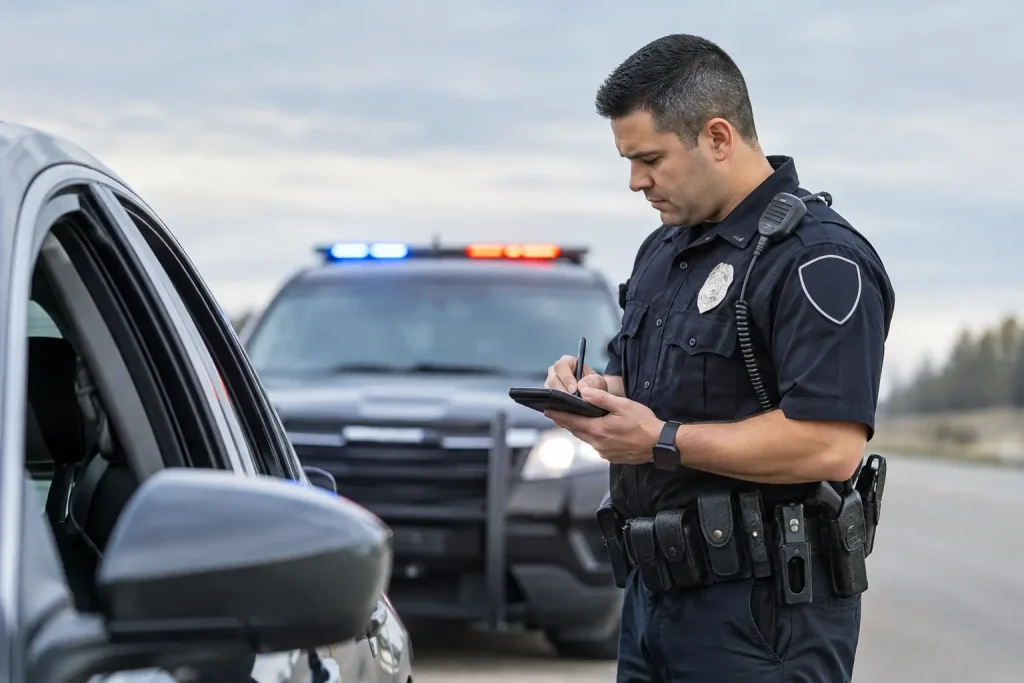
A flashing squad car in the rearview mirror can set an entire criminal case in motion. But a badge and emergency lights do not give law enforcement unlimited authority. Traffic stop suppression is the legal process of asking a court to exclude evidence police obtained after an unlawful stop, detention, search, or interrogation. In a Minnesota DWI, drug, firearm, or other criminal case, that evidence may be the state’s foundation. If the foundation was built on a constitutional violation, it can be challenged.
Suppression is not a technicality. It is a safeguard against the government using evidence obtained by crossing the line. The question is not whether an officer suspected wrongdoing. The question is whether the officer had lawful grounds at each stage of the encounter.
What Traffic Stop Suppression Means
A suppression motion asks the judge to keep certain evidence out of the case. That can include a driver’s statements, field sobriety test results, evidence found during a vehicle search, blood or urine test results, or items seized from a person or vehicle.
The usual issue begins at the first moment of contact: Why was the vehicle stopped? Police generally need at least reasonable, articulable suspicion that a traffic or criminal-law violation occurred. That standard is lower than proof beyond a reasonable doubt, but it is not a free pass to stop anyone based on a hunch.
A valid stop also does not authorize an officer to do whatever they want afterward. The detention must remain reasonably related in scope and duration to the reason for the stop, unless new facts create lawful grounds to expand the investigation. A burned-out light, for example, may justify addressing an equipment violation. It does not automatically justify a prolonged drug investigation, a vehicle search, or a fishing expedition into a driver’s private life.
If a judge grants suppression, the state may lose critical evidence. Sometimes that changes the direction of a case. Sometimes it leaves the prosecution without enough admissible proof to proceed. Other times, the state may still have evidence that survives the ruling. Every case turns on the facts, the available video, the reports, and the law governing the specific evidence at issue.
The Stop Must Have a Lawful Reason
Many people assume that if an officer writes a ticket or cites a traffic statute, the stop must have been lawful. That is not always true. A defense attorney looks beyond the label and asks what the officer actually observed before activating the lights.
Did the squad video show the claimed lane violation? Was a plate check accurate? Could the officer truly see the alleged equipment defect? Did dispatch provide reliable information, or was the stop based on a vague report? Small details matter because the state must be able to point to specific facts, not a conclusion written after the fact.
An officer may make a stop for an actual traffic violation even if the officer also hopes to investigate something else. That is a difficult reality in many cases. But the objective basis still must exist. If the alleged violation did not happen, the officer was mistaken about the law, or the stated reason is contradicted by video, a suppression challenge may be available.
A Stop Can Become an Unlawful Detention
The constitutional analysis does not end once the car is pulled over. An initially lawful stop can become unlawful when its purpose is completed and police extend it without adequate justification.
Officers may generally take reasonable steps connected to the traffic matter, such as checking identification, registration, insurance, and warrants. They can also respond to facts that create new, particularized suspicion of impairment or another offense. The critical question is whether the officer had real, observable reasons to broaden or prolong the stop.
For example, an officer may claim a driver had watery eyes, slurred speech, an odor of alcohol or cannabis, nervous behavior, or inconsistent answers. Those observations must be tested, not accepted automatically. Video may show a calm, coherent driver. Medical conditions, fatigue, allergies, ordinary anxiety, or the presence of a lawful passenger can have innocent explanations. A careful defense does not simply repeat the report. It compares the report with what occurred.
Searches Are Not Automatically Permitted
A vehicle stop is not a blanket permission slip to search a vehicle. The Fourth Amendment and Minnesota law place limits on when police may search a person, passenger compartment, trunk, backpack, phone, or other closed container.
Consent is one common issue. Police may claim that a driver agreed to a search, but consent must be voluntary. The setting matters. A person surrounded by officers, unsure whether they are free to leave, or responding to a command rather than a genuine request may not have given meaningful consent. The exact words used by the officer can be decisive.
Other searches may be defended as incident to arrest, based on probable cause, for officer safety, or under an inventory-search policy after a vehicle is impounded. Each theory has boundaries. An officer cannot use the phrase “officer safety” as a substitute for facts. An inventory search cannot become a pretext for an investigative search. And probable cause must rest on circumstances that existed before the search, not evidence found afterward.
Digital evidence deserves special attention. A phone found in a vehicle or on a person does not ordinarily give police unlimited authority to search its contents without proper legal authority. Messages, location data, photographs, and app information can be deeply personal. The government’s interest in investigating a charge does not erase privacy protections.
DWI Cases Require a Separate, Detailed Review
In a Minnesota DWI case, a traffic stop often leads quickly to roadside questioning, field sobriety tests, a preliminary breath test, arrest, and chemical testing. Each stage creates a separate question for the defense.
Were field sobriety tests administered correctly and under conditions that made them reliable? Uneven pavement, poor lighting, winter weather, footwear, injury, age, and language barriers can affect performance. Was the preliminary breath test used as an investigative tool, or did the officer overstate its significance? Did police have probable cause to arrest before requesting further testing?
Chemical testing carries its own legal issues. Depending on the circumstances, the defense may examine the advisory given to the driver, whether a warrant was obtained, whether a test refusal was handled lawfully, the timing of the sample, test procedures, and whether a claimed substance actually explains impairment. Cannabis and prescription-medication cases are especially fact-sensitive. The presence of a substance is not automatically the same as proof of impaired driving.
A successful traffic stop suppression motion can affect both the criminal charge and related license consequences. But those matters can follow different procedures and deadlines. A driver should not assume that fighting the criminal case alone protects driving privileges. Fast action matters.
Evidence Must Be Preserved Before It Disappears
The strongest suppression arguments are often built from evidence outside the police report. Squad video, body-camera footage, 911 recordings, dispatch logs, jail calls, booking video, test records, towing records, and witness accounts can show what occurred from different angles.
This is why waiting can be costly. Video retention policies vary. Witness memories fade. A vehicle may be repaired or released. The defense needs time to preserve records, identify discrepancies, and determine whether the state can prove a lawful basis for every escalation.
A former prosecutor or law-enforcement perspective can help identify where an investigation may have gone wrong, but no two stops are alike. A minor factual difference can change the legal analysis. The reported odor of alcohol may support further inquiry in one situation, while vague assertions with no supporting video may be vulnerable in another.
What to Do After a Questionable Stop
Do not try to litigate the stop on the roadside. Remain calm, avoid physical resistance, and do not volunteer explanations that may later be used against you. You can clearly say that you want to remain silent and want to speak with an attorney. Do not consent to a search merely because an officer asks, unless you have received legal advice and understand the consequences.
After release, write down everything you remember while the details are still clear: where the stop occurred, the time, what the officer said, what you said, whether there were passengers, what tests were requested, and whether cameras were visible. Keep all paperwork, citations, tow documents, and temporary-license materials. Then get legal advice promptly.
A charge is not a verdict, and an officer’s report is not the final account of what happened. When the government seeks to take your license, your record, your livelihood, or your freedom, it must be held to the Constitution at every turn. The best next step is to put the stop under a careful, unflinching review before critical evidence and deadlines slip away.