
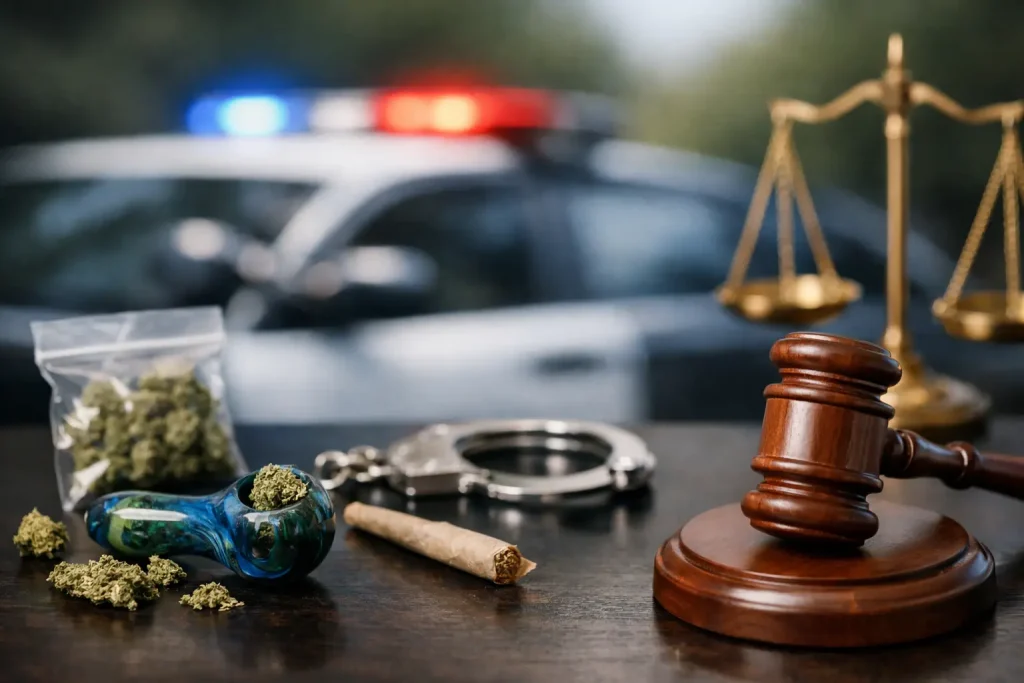
A THC DWI arrest can feel like the state has already decided what happened. An officer says they smelled cannabis, noticed red eyes, or believed your field sobriety tests showed impairment. But the best defenses for THC DWI cases often begin with a basic question: can the state actually prove you were impaired while driving, rather than merely prove you used cannabis at some earlier time?
That distinction matters. Cannabis compounds and metabolites may remain detectable after the effects have ended. A charge, a blood result, or an officer’s opinion is not the same as proof beyond a reasonable doubt. In Minnesota, a strong defense examines every stage of the case: the traffic stop, the roadside investigation, the testing process, the officer’s conclusions, and the timing of alleged use.
A THC DWI Is an Impairment Case, Not a Guess
Minnesota prosecutors may pursue a DWI allegation when they claim a driver was under the influence of a controlled substance. In a cannabis case, the central issue is usually impairment at the time of driving. The state still bears the burden of proving its case. It cannot replace proof with suspicion, stigma, or the assumption that a person who has THC in their system must have been unsafe behind the wheel.
Unlike alcohol cases, there is no simple roadside THC number that reliably establishes present impairment for every driver. People process cannabis differently. The amount consumed, method of consumption, frequency of use, body chemistry, medication, sleep, illness, and the passage of time can all affect what a test may show and how a person appears.
That does not mean every THC DWI can be defeated. It means the facts must be tested rather than accepted. A defense lawyer should look for the gap between the state’s theory and what the evidence can truly support.
The Best Defenses for THC DWI Often Start With the Stop
Police need a lawful basis to stop a vehicle. A valid stop may arise from an observed traffic violation, equipment issue, or specific facts suggesting criminal activity. But an officer cannot stop a driver based on a hunch.
The first defense question is simple: what did the officer actually observe before activating emergency lights? Vague claims such as “driving suspiciously” may not be enough without specific details. Video footage can be critical here. It may confirm a lane violation or speeding allegation, but it can also expose exaggeration, show normal driving, or reveal that the officer’s report does not match the recording.
Even if the initial stop was lawful, the officer cannot extend it indefinitely without a lawful reason. A routine traffic stop can become an impaired-driving investigation only when new facts reasonably support that expansion. The smell of cannabis, an admission of recent use, physical observations, or driving behavior may be argued as reasons for further investigation. Each claimed fact must be examined in context.
Legal cannabis use does not surrender a driver’s constitutional protections. The question is not whether cannabis is legal or illegal in the abstract. The question is whether police acted lawfully and whether the evidence proves impairment.
Roadside Statements Can Become the State’s Story
Officers often ask questions designed to establish a timeline: When did you last use? How much did you use? Do you feel high? Have you taken any medications? Under stress, many people guess, minimize, overexplain, or try to be cooperative in ways that later sound damaging.
You do not have to explain your life away on the roadside. Remain calm, provide required identifying information, and do not volunteer details about cannabis use or medications. If you are arrested, clearly ask to speak with a lawyer before making significant decisions or answering investigative questions.
Field Sobriety Tests Are Not THC Detectors
Standardized field sobriety tests were developed primarily around alcohol impairment. They are often treated as decisive, but they are not machines and they do not measure THC in a person’s body. They require an officer to make subjective judgments about balance, eye movements, divided attention, and instructions.
Many sober people can perform poorly for reasons that have nothing to do with cannabis. Uneven pavement, winter weather, poor lighting, anxiety, fatigue, age, injury, footwear, a medical condition, or language barriers can affect performance. A person with knee, back, inner-ear, or neurological issues may have particular difficulty.
A careful defense compares the report with body-camera and squad-camera footage. Did the officer give accurate instructions? Was the surface safe? Did the driver actually make the errors claimed? Did the officer account for a disclosed injury? Video sometimes tells a more reliable story than a checklist completed after an arrest.
Drug Recognition Evaluations Require Scrutiny
Some officers are trained as drug recognition experts, often called DREs. Their evaluations may include observations of pulse, pupil size, muscle tone, eye movement, coordination, and other indicators. Training does not make an opinion infallible.
A DRE opinion can be challenged through the conditions of the evaluation, adherence to protocol, other medical explanations, inconsistent findings, and the officer’s own assumptions. Red eyes, nervousness, dry mouth, or a rapid pulse are not unique to cannabis impairment. They can result from allergies, stress, lack of sleep, medical issues, or the pressure of being detained by police.
Blood and Urine Evidence May Not Prove When Impairment Occurred
A chemical test can sound powerful in court because it produces a scientific-looking result. Yet the meaning of that result is often the real fight. Detecting THC or a cannabis-related compound does not automatically reveal when it was consumed, how much a person used, or whether the person was impaired while driving.
This issue is especially significant when time passes between the stop and the blood draw. The state may be attempting to work backward from a later sample to a claim about an earlier moment. The defense should examine the timeline closely: when the vehicle was stopped, when roadside testing began, when an arrest occurred, when a warrant was sought if one was required, and when the sample was collected.
The collection and analysis process also deserve attention. Was the sample properly obtained? Was consent voluntary, or was a warrant valid? Were required procedures followed? Was the chain of custody documented? Did the laboratory use accepted methods, and can the reported result be interpreted as the prosecutor claims? These questions are not technical distractions. They may determine whether key evidence is admissible or persuasive.
Urine testing can present additional timing problems because it may indicate past exposure without reliably establishing impairment during the drive. A defense strategy should match the type of test, the reported substance, and the state’s exact allegation.
Alternative Explanations Can Create Reasonable Doubt
A THC DWI case is rarely built on one fact. Prosecutors may point to driving, appearance, statements, field tests, officer opinions, and a chemical result. The defense must examine whether those pieces actually fit together.
Perhaps the driver was tired after a long shift. Perhaps bloodshot eyes came from allergies. Perhaps poor balance came from a documented injury. Perhaps a prescription medication, medical condition, or ordinary nervousness explains the officer’s observations. Perhaps the vehicle movement was minor and caused by road conditions, construction, or an evasive maneuver.
An alternative explanation does not need to prove innocence by itself. It must be credible enough to expose the weakness in the state’s claim that THC impairment is the only reasonable explanation. The strongest defenses are grounded in records, video, witness testimony, medical information when appropriate, and a disciplined reading of the evidence.
Protect Your License as Well as Your Criminal Case
A DWI arrest can trigger more than a court charge. It may also affect your driving privileges through Minnesota’s implied-consent and license-revocation process. These are related matters, but they are not always resolved on the same track or timeline.
Deadlines can be short. In many Minnesota license-revocation matters, a petition for judicial review must be filed within 60 days of receiving notice. Missing that deadline can close off an important opportunity to challenge the revocation. A lawyer should review the paperwork immediately, including the notice given by law enforcement, any temporary license, test documents, and the dates listed on each form.
Do not assume the criminal case will automatically protect your license. Do not assume a future court date means there is time to wait. The early days after an arrest are often when video can be preserved, witnesses can be located, and procedural challenges can be raised before the record hardens against you.
A THC DWI accusation is a legal storm, but it is not a verdict. Get the reports, preserve the evidence, protect your deadlines, and put a capable legal shield between you and a system that may be moving faster than the facts.
Pingback: DWI Dismissal Examples Under Minnesota Law – Refuge Defense
Pingback: THC Presence Versus Impairment in Minnesota – Refuge Defense