
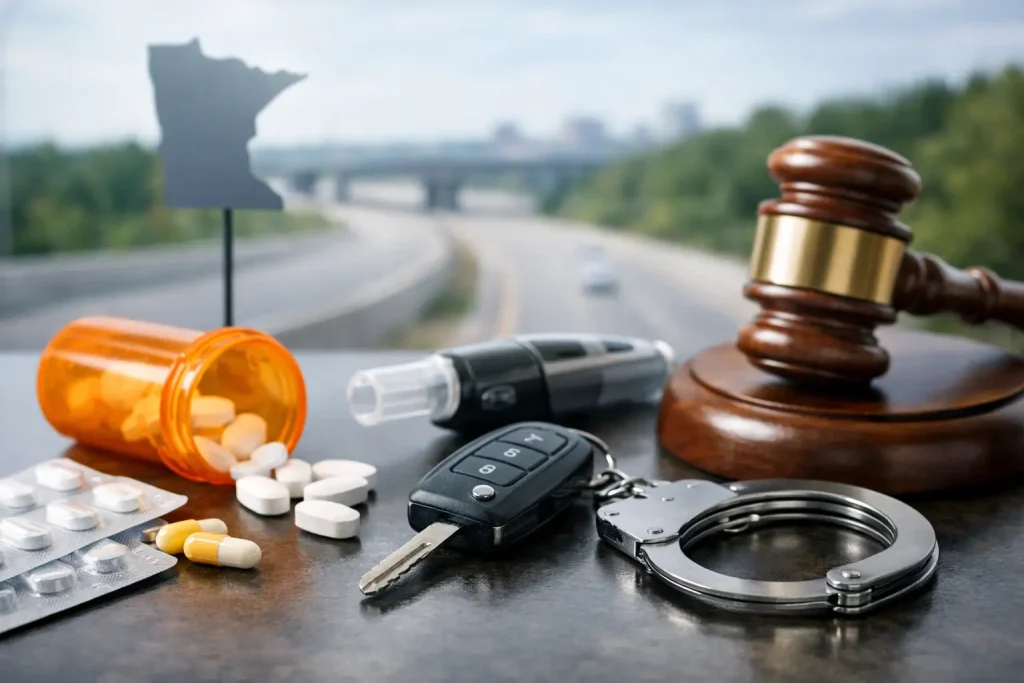
A lawful prescription can still place you in handcuffs, facing a revoked license, and wondering how the state can call you impaired. This prescription drug DWI guide explains the immediate decisions that matter in Minnesota. The bottle in your medicine cabinet is not a shield against a DWI allegation, but neither is an officer’s suspicion the final word.
Prescription-drug DWI cases are often built on judgment calls: an officer’s description of your eyes, your speech, your balance, or the way you performed roadside tests. Those details can be challenged. But the first hours and days after an arrest are critical. Protect your rights before deadlines and evidence begin working against you.
A Prescription Drug DWI Charge Is Not Just About the Prescription
Minnesota can pursue a DWI allegation when the state claims a driver was under the influence of a controlled substance, an intoxicating substance, or a combination of substances. That can include medications prescribed for pain, anxiety, sleep, attention disorders, seizures, muscle spasms, or other medical conditions.
The central question is not always whether you took more medication than prescribed. The state may argue that even properly prescribed medication affected your ability to drive. It may point to delayed responses, lane movement, a minor crash, statements made during the stop, or an officer’s interpretation of standardized field sobriety tests.
Some cases also involve allegations based on the presence of certain controlled substances in a person’s body. The law in this area is technical. A valid prescription, the drug involved, the test used, the concentration reported, and the exact charging theory can all matter. Do not assume that a positive blood or urine result automatically proves impairment. A test can show exposure to a substance, but it does not always show when it was taken, what effect it had at the time of driving, or whether it caused unsafe driving.
That distinction is where a defense often begins.
What Police May Look for During a Prescription Drug DWI Stop
Unlike alcohol cases, there is no roadside breath test that measures impairment from most prescription drugs. Officers often rely heavily on observations. They may say your pupils appeared unusual, your eyelids drooped, you seemed confused, you spoke slowly, or you had trouble following instructions.
Those observations can have innocent explanations. Fatigue, a medical condition, stress, injury, poor lighting, cold weather, uneven pavement, age, disability, or anxiety during a police encounter can affect balance and performance. A person dealing with chronic pain may not move like a healthy person on a flat, well-lit surface. That does not mean the person was impaired behind the wheel.
Police may call a Drug Recognition Evaluator, sometimes called a DRE. A DRE evaluation is a multi-step process designed to identify possible drug impairment. It is not infallible. The defense can examine whether the evaluation was conducted correctly, whether the officer had adequate grounds to request it, whether medical explanations were ignored, and whether the conclusion matches the actual evidence.
Medication containers, pills, pharmacy records, and statements about your health can become part of the state’s case. Remain calm. Do not resist or argue roadside. Provide required identification, but do not try to explain away the situation through a long conversation. You have the right to remain silent. Use it.
Blood and Urine Tests: Positive Does Not Mean Impaired
A prescription drug DWI investigation may lead to a request for a blood or urine test. The state may use the result to argue that a controlled substance was present. Yet toxicology is rarely as simple as a police report makes it sound.
Many medications remain detectable long after their strongest effects have passed. Others produce metabolites that reveal prior use but say little about impairment at the time of driving. A therapeutic level may be consistent with appropriate medical use. Individual tolerance also varies, especially for people who have taken a medication under medical supervision for an extended period.
The type of specimen matters as well. Blood and urine answer different scientific questions. Collection procedures, laboratory handling, chain of custody, testing methods, and the way results are interpreted deserve close review. A result should not be accepted as a shortcut around proof.
Do not make a snap decision about chemical testing based on a friend’s story or an internet rule. Minnesota’s implied-consent laws can carry serious consequences, and a refusal allegation can create a separate legal problem. Ask to speak with an attorney. Minnesota law generally recognizes a limited right to consult counsel before deciding whether to test, as long as doing so does not unreasonably delay the process. Exercise that right clearly and respectfully.
Protect Your License Before the Deadline Passes
A DWI arrest can trigger two separate fights. One is the criminal case. The other is the driver’s-license revocation or cancellation process. They may arise from the same stop, but they are not the same proceeding and should not be treated as one.
If you receive a notice of revocation, act immediately. In many Minnesota implied-consent cases, a petition for judicial review must be filed within 60 days after notice is received. Missing that window can mean losing the opportunity to challenge the revocation in court, even while the criminal case is still pending.
Read every document before you leave the jail or station. Keep the citation, notice of revocation, temporary-license paperwork, test advisory, and any property receipt together. Write down the timeline while it is fresh: where you were stopped, what the officer said, whether dash or body camera footage may exist, what tests were requested, and any medical symptoms you were experiencing.
Do not continue driving after a revocation takes effect unless you have confirmed that you are legally permitted to drive. A limited license may be available in some circumstances, but eligibility depends on the facts of the case and your driving history.
Build the Defense Around the Real Facts
A strong prescription medication DWI defense is not built from one generic argument. It is built by testing every link in the state’s chain of proof.
The stop itself may be at issue. Police need a lawful basis to stop or seize a driver. A claimed traffic violation must be supported by actual facts, not a vague hunch. If the stop was unlawful, evidence gathered afterward may be challenged.
The driving evidence matters, too. Was there truly dangerous or erratic driving? Was the alleged violation brief, explainable, or contradicted by video? A marked lane on an officer’s report can look very different when viewed on squad footage.
Then comes the impairment evidence. An experienced defense review considers medical history, prescription instructions, timing of doses, dosage changes, sleep deprivation, injuries, and other factors that could explain observations. It also examines whether officers used field sobriety tests fairly and whether their reports accurately reflect what happened.
Finally, the scientific evidence must be scrutinized. A laboratory report may sound decisive, but it is still evidence that must be interpreted in context. The prosecution must prove its case beyond a reasonable doubt. It does not get to replace proof with assumptions about medication or illness.
What to Do After a Prescription Drug DWI Arrest
Your next steps should be deliberate. Preserve your paperwork and do not discuss the facts of the stop with coworkers, friends, or social media. Do not contact witnesses yourself in a way that could be misunderstood. Gather the names of your prescribing providers and pharmacies, but do not hand over broad medical records without legal advice. Medical information may help your defense, but it should be reviewed strategically, not surrendered blindly.
Write down what you took, when you took it, and how you normally respond to the medication. Include over-the-counter drugs, cannabis products, alcohol, and supplements if they were involved. A complete and honest account allows counsel to identify risks before the state does.
Then get legal help quickly. Refuge Defense approaches these cases as more than a court date. Your license, job, record, family stability, and freedom may all be on the line. The state has investigators, reports, testing procedures, and prosecutors working its side. You deserve a defender prepared to test the evidence and stand between you and the weight of the system.
A prescription is part of your medical care, not an admission of guilt. Take the charge seriously, protect the license deadline, and make sure someone examines the case before the state’s version becomes the only version heard.