
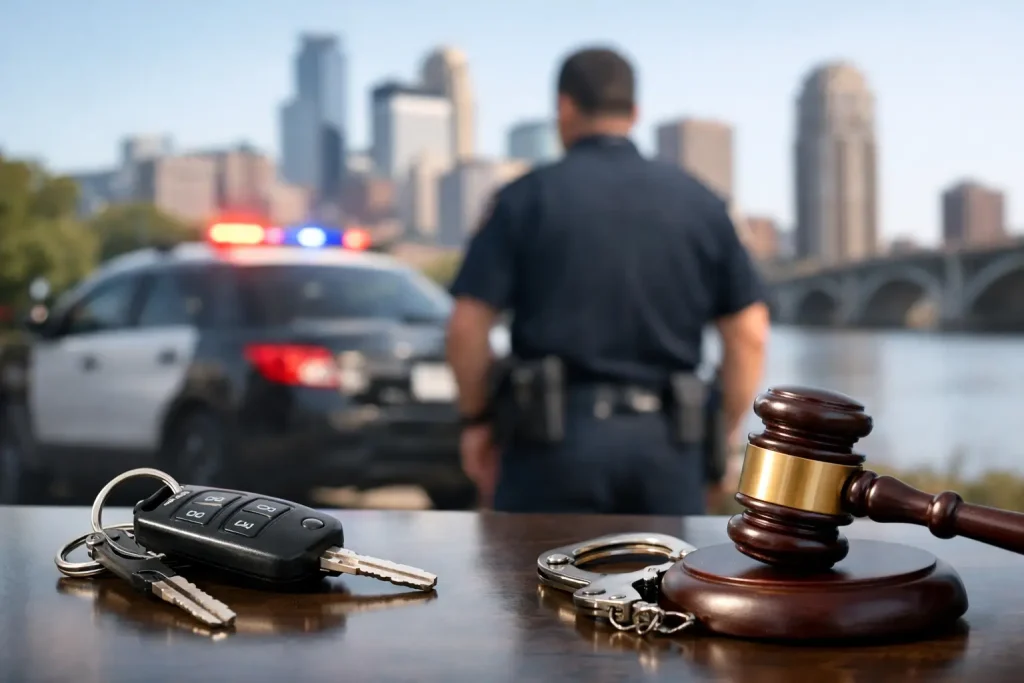
The moment you refuse a chemical test after a Minnesota DWI arrest, the case can move on two separate tracks: your driver’s license and the criminal allegation. If you are asking what happens after chemical refusal, the short answer is that the officer may arrest you, take your license, seek a warrant for another test, and forward the case for charging. But refusal is not the end of the story, and it is not a conviction.
The hours after an arrest can feel like a legal storm moving too fast to understand. Clear action matters. Protect your right to challenge the revocation, preserve what happened during the stop and at the police station, and avoid making statements that give the state more evidence.
What Chemical Refusal Means Under Minnesota Law
Minnesota’s implied-consent law generally requires drivers lawfully arrested for DWI to take a chemical test when an officer has the legal basis to request one. The requested test may involve breath, blood, or urine, depending on the circumstances. Breath testing is common in alcohol-related cases. When police suspect drugs, cannabis, or prescription medication, they may pursue blood or urine testing, often after a drug-recognition evaluation.
A refusal is more than saying the word “no.” It can also arise when police claim a driver failed to provide an adequate sample, deliberately delayed, or would not follow testing instructions. That does not mean the officer’s conclusion is automatically right. A true medical limitation, confusing directions, equipment problems, language barriers, or conduct that officers incorrectly label as noncooperation can matter greatly.
Whether a refusal was legally valid depends on the facts. The legality of the traffic stop, the arrest, the advisory process, the type of test requested, and what the officer actually said and did all deserve close examination.
What Happens After Chemical Refusal at the Police Station
After an alleged refusal, an officer will usually complete paperwork documenting the request and your response. You may be booked into jail, photographed, fingerprinted, and held until release conditions are met or you are sober enough for release. Your vehicle may be towed or released to another licensed driver.
Police may also seek a search warrant for a blood or urine sample. Refusing an initial test does not always prevent the state from obtaining chemical evidence later. If a warrant is issued and executed, the result may become central evidence in the DWI case. The warrant process itself must still be reviewed. Officers need a legally sufficient basis, and how they obtained and carried out the warrant can raise serious constitutional questions.
The state may rely on evidence other than a test result as well. Officers commonly point to driving conduct, body-camera footage, squad video, field sobriety tests, statements, physical appearance, odor of alcohol, or drug-recognition observations. For cannabis and prescription-drug allegations, the absence of a clean numerical test result can make the officer’s observations more important, but it can also expose weaknesses in the state’s proof.
Your License Revocation Can Start Before Court
One of the most immediate consequences of a chemical-test refusal is an administrative driver’s license revocation. In many first-refusal cases, the revocation period is one year. Prior impaired-driving incidents, aggravating facts, commercial driving issues, and other circumstances can change the consequences and may extend the loss of driving privileges.
The officer or Department of Public Safety paperwork should identify the date the revocation begins and explain the process for seeking review. Do not set those documents aside. In Minnesota, a petition for judicial review of an implied-consent revocation generally must be filed within 60 days of receiving the notice and order of revocation. Miss that deadline, and you can lose a major opportunity to challenge the revocation in court.
A license revocation does not necessarily mean you will have no lawful way to drive for the entire period. Some drivers may qualify for limited driving privileges or Minnesota’s ignition interlock program. Eligibility is highly fact-specific. It can depend on your record, the alleged offense, whether you own or have access to a vehicle, and whether you meet program requirements.
Do not drive until you know your status. Driving after withdrawal or revocation can create a new criminal problem and give prosecutors additional leverage in the original case.
A Refusal May Also Lead to Criminal Charges
The license case and criminal case are related, but they are not the same proceeding. A prosecutor may charge DWI based on alleged impairment, and the state may also pursue a test-refusal allegation when Minnesota law and the specific test circumstances support it.
The level of the charge can depend on the facts and your prior record. A first offense may be charged as a misdemeanor or gross misdemeanor in certain circumstances. Prior impaired-driving incidents, an alleged high alcohol concentration, a child in the vehicle, or other aggravating factors can increase the stakes. Repeat allegations can lead to felony exposure, vehicle forfeiture issues, longer license consequences, and threats to employment, professional licensing, firearms rights, and family stability.
A charge is not proof. The prosecutor must prove each required element beyond a reasonable doubt. That includes more than showing that an officer asked for a test and did not receive one. The defense may challenge whether police had a lawful basis to stop and arrest you, whether the testing request was authorized, whether the advisory was properly delivered, and whether your conduct actually amounted to a refusal.
The First Steps That Protect Your Defense
Time can erase evidence. Video systems overwrite recordings, witnesses forget details, and a police report often becomes the state’s first version of events. Your defense should begin before that version hardens into the only version.
Write down what you remember as soon as you can do so accurately. Include where you were stopped, what the officer said, whether you asked questions, whether you had a medical condition, what test was requested, and exactly what happened when testing began. Keep every document you received, including the notice of revocation, temporary license paperwork, tow information, bail paperwork, and court notice.
Just as importantly, do not try to explain the incident away through texts, social media posts, or informal conversations. Statements that feel harmless can be taken out of context later. Speak candidly with your defense lawyer instead. That conversation is where the full story belongs.
Evidence Worth Investigating
A targeted defense looks beyond the officer’s conclusion. It may involve examining squad and body-camera video, dispatch records, jail video, testing-machine records, the timing of the implied-consent advisory, warrant materials, medical records, and testimony from people who saw you before the stop.
The issue may be straightforward, or it may be technical. For example, a driver who cannot blow because of a documented respiratory problem presents a different question than a driver accused of intentionally avoiding a breath sample. A drug-impaired driving case involving a warrant, a blood draw, and a drug-recognition evaluation requires a different level of scrutiny than an alcohol case built around a roadside stop.
Do Not Assume Refusal Was the Wrong Choice or a Lost Case
People often second-guess everything after a DWI arrest. Some refused because they were afraid, confused, sick, or believed the test was unreliable. Others had consumed alcohol or used medication and feared a result. The legal consequences of refusal can be serious, but there is no universal answer to whether refusing was “better” or “worse” than testing. The answer depends on the evidence police had, the kind of test requested, your history, and whether officers followed the law.
What matters now is disciplined defense. A chemical refusal case can involve rapid deadlines, constitutional issues, forensic questions, and serious personal consequences. You deserve someone who will inspect the state’s case rather than accept its labels.
If your license is at risk or you have been charged after an alleged refusal in Minneapolis, Saint Paul, or the surrounding Minnesota communities, act before the 60-day review window closes. Refuge Defense can help build a shield around your rights, your record, and the life waiting for you beyond this case.
Refusal is a crime in Minnesota.
Pingback: How to Respond Police Questioning in Minnesota – Refuge Defense
Pingback: DWI Versus DUI in Minnesota and What It Means – Refuge Defense
Pingback: 10 Top Mistakes After Arrest in Minnesota – Refuge Defense
Pingback: How to Invoke Counsel When Police Question You – Refuge Defense